
Table of Contents
- What Makes Beef Tallow Moisturizer Different
- Grass-Fed Tallow Benefits for Skin Health
- Is Tallow Comedogenic? What the Rating Actually Means
- How to Use Tallow Balm in Your Routine
- Eczema, Psoriasis, and Dry Skin: What Tallow Can and Cannot Do
- Sourcing and Sustainability: How to Verify Quality
- Frequently Asked Questions
Last Updated: September 29, 2026
What Makes Beef Tallow Moisturizer Different
Beef tallow moisturizer is a skincare product made from rendered beef fat that closely mirrors the lipid structure of human skin. This similarity allows it to absorb deeply while supporting the skin barrier. Unlike water-based creams that evaporate quickly, tallow creates a lasting protective layer.
Fatty Acid Profile: Stearic and Oleic Acid
The fatty acid composition of tallow explains much of its behavior on skin. Stearic acid, which makes up a significant portion of tallow, provides a protective, occlusive quality that helps seal in moisture. Oleic acid, meanwhile, is more fluid and helps the product spread easily.
Vitamins A, D, E, and K in Rendered Fat
Rendered fat from grass-fed cattle carries fat-soluble vitamins: A, D, E, and K. These vitamins are bioavailable in tallow because fat is their natural carrier. Vitamin A supports skin cell turnover. Vitamin E offers antioxidant properties. Vitamins D and K contribute to overall skin health.
Grass-Fed Tallow Benefits for Skin Health
Grass-fed tallow benefits start with its lipid profile. When cattle eat grass rather than grain, their fat tends to contain a better ratio of omega-3 to omega-6 fatty acids. That ratio influences how the tallow interacts with skin inflammation pathways.
Skin Barrier Support and Transepidermal Water Loss
The skin barrier is your body's first defense against moisture loss and irritants. When that barrier weakens, transepidermal water loss increases, and skin feels tight, flaky, or raw.
Is Tallow Comedogenic? What the Rating Actually Means
Tallow carries a comedogenic rating of 2 on the standard 0-5 scale, which places it in the "low risk" band for most people. The scale estimates how likely an ingredient is to form comedones, the plugged pores that precede closed bumps and inflammatory acne. Ratings of 0-2 are generally considered low-risk; 3-5 are higher-risk. For context, coconut oil typically rates a 4, cocoa butter a 4, and jojoba oil a 2.
Where the Rating Comes From, and Why It's Imperfect
The comedogenic scale traces back to rabbit-ear studies conducted in the 1970s and 1980s, in which ingredients were applied to the inside of a rabbit's ear and the resulting follicular changes were scored. Rabbit skin has a different follicular density and sebum composition than human facial skin, so the results don't translate perfectly. The scale also tests raw ingredients in isolation, not finished formulas.
How Tallow's Fatty Acids Map to the Rating
Tallow's behavior comes down to its fatty acid split. Stearic acid, the dominant saturated fat in beef tallow, is generally regarded as low on the comedogenic scale and contributes the firm, occlusive quality that seals in moisture. Oleic acid, a monounsaturated fat, is the component most often linked to pore congestion in acne-prone skin; it's the same fatty acid that gives olive oil and coconut oil their higher ratings.
What This Means If You're Acne-Prone
A rating of 2 is not a guarantee. "Natural" and "non-comedogenic" are not synonyms, coconut oil is natural and rates a 4. If you have oily, hormonal, or cystic acne, treat any new tallow balm as a test, not a staple:
- Patch-test on your jawline or behind one ear for 7-10 days before applying to your full face.
- Introduce it at night only, so you can observe your skin in the morning before layering anything else.
- Watch for closed comedones (small, flesh-colored bumps) along the T-zone, chin, and hairline, these typically appear within two weeks if a product is going to clog you.
- If you're already using an active like adapalene, benzoyl peroxide, or salicylic acid, note that a heavy occlusive can trap the active against skin and increase irritation. Some users alternate nights rather than layering.
The Unique Angle Most Guides Skip
Almost every tallow article repeats the "rating of 2" line without explaining that the rating was never designed for leave-on facial balms, or that the same balm can rate differently depending on how much oleic-rich oil is blended in. If a brand lists tallow first and olive oil or avocado oil second, the effective comedogenic profile is closer to the second ingredient than the first.
How to Use Tallow Balm in Your Routine
Using tallow balm is simpler than most routines suggest. Warm a pea-sized amount between your fingertips and press it into damp skin after cleansing. The whipped balm texture melts on contact, so you need far less than you'd expect.
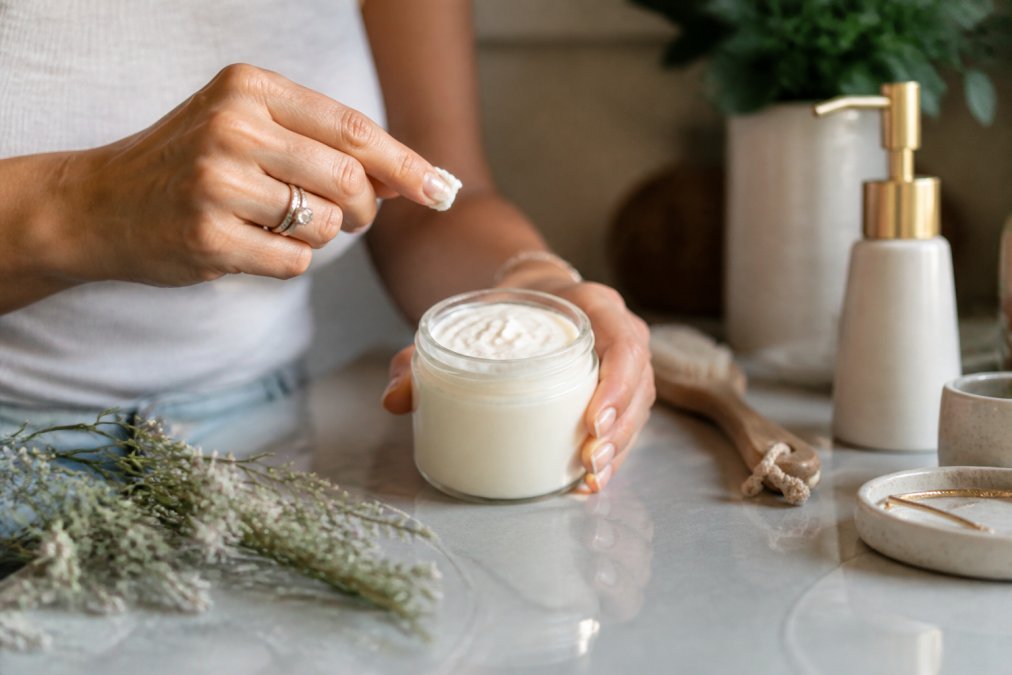
A basic sequence looks like this:
- Cleanse with a gentle, synthetic-free wash
- Mist or pat skin so it's slightly damp
- Warm a small amount of balm between palms
- Press into face and neck, focusing on dry patches
- Apply at night for best absorption; use sparingly in the morning (Source: comedogenic rating system)
Managing Scent and Texture
Beef tallow has a natural, faintly beefy scent. Most commercial balms handle this in one of three ways: heavy purification process steps that strip odor, essential oils that mask it, or a blend of carrier oils that dilutes it.
Eczema, Psoriasis, and Dry Skin: What Tallow Can and Cannot Do
Tallow can support skin hydration and reduce moisture loss, which helps many people manage dryness and mild irritation. It is not a treatment for eczema relief or psoriasis management in a medical sense. Those are conditions that need a dermatologist's care.
| Skin Concern | What Tallow Can Do | What It Cannot Do |
|---|---|---|
| Dry skin | Seal in moisture, reduce flaking | Replace medical treatment |
| Eczema | Soothe mild irritation, support barrier | Cure flare-ups |
| Psoriasis | Reduce scaling from dryness | Treat plaques |
| Acne-prone | Work if patch-tested carefully | Guarantee no clogged pores |
| Sensitive skin | Limit irritant exposure | Prevent all reactions |
Sourcing and Sustainability: How to Verify Quality
The quality of a tallow moisturizer depends almost entirely on its source. Grass-fed beef tallow from pasture-raised cattle tends to carry a better lipid profile and higher fat-soluble vitamin content than fat from feedlot animals. But "grass-fed" is not a tightly enforced term for cosmetics in the way it is for some food categories, so the label alone proves very little.
Certifications Worth Looking For
- USDA Certified Organic, the strongest single signal for the fat itself. It restricts synthetic pesticides, hormones, and antibiotics, and requires an audit trail from farm to processor.
- Certified Humane Raised and Handled, a third-party animal welfare program with published standards for pasture access, space, and handling. It's one of the few welfare labels with on-farm audits.
- Animal Welfare Approved (A Greener World), a pasture-based standard that requires continuous outdoor access and prohibits feedlots. It's stricter than most, and the list of certified farms is public.
- Regenerative Organic Certified, layers soil-health, animal-welfare, and social-fairness requirements on top of organic. Rare in skincare, but increasingly seen from small tallow brands.
- Land to Market / Savory Institute, verifies regenerative grazing outcomes at the land level rather than the product level. Useful as a supporting claim, not a standalone one.
A brand that names one of these programs and can point to the certifying body is doing more than a brand that simply prints "grass-fed" on a jar.
Questions That Separate Transparency From Marketing
If a brand can't answer these, treat the sourcing claim as decoration:
- Which farm or ranch supplies the fat? A named operation, not "a cooperative in the Midwest", is the baseline.
- What is the breed and diet? 100% grass-fed and finished is different from grass-fed plus grain finishing.
- How is the fat rendered? Low-heat or cold-rendered fat preserves more vitamins; high-heat rendering is faster and cheaper but degrades some of the vitamin-rich content.
- Is the tallow from suet (kidney fat) or trim? Suet is firmer, lower in odor, and generally considered the higher-quality cosmetic fat.
- Are welfare audits published? A brand that links to its certifier's farm list is more credible than one that describes its practices in adjectives.
Sustainability Beyond the Label
For broader guidance on cosmetic ingredient safety and labeling, the FDA's cosmetics information page outlines what manufacturers may and may not claim. The American Academy of Dermatology also publishes general skin care guidance worth reviewing before overhauling your routine.
Frequently Asked Questions
Is beef tallow good as a moisturizer?
Beef tallow is an emollient rich in stearic and oleic acid, plus vitamins A, D, E, and K. These properties help support the skin barrier and reduce transepidermal water loss. Many people find it deeply hydrating without needing frequent reapplication. However, results vary by skin type, and tallow is not a treatment for medical skin conditions. Patch-test first and consult a dermatologist if you have persistent concerns.
Is tallow comedogenic, and will it clog my pores?
Tallow's comedogenic rating is debated. Some sources rate it around 2 on a 0-5 scale, meaning it is unlikely to clog most people's pores. Its fatty acid profile closely resembles human sebum, which may help it absorb without sitting heavily on the surface. That said, individual reactions vary. If you have oily or acne-prone skin, start with a thin layer and monitor how your skin responds.
How do I use tallow balm for the best results?
Apply a pea-sized amount of tallow balm to clean, slightly damp skin. Warm it between your fingertips first, then press it into your face and neck. Use it as the last step in your evening routine to seal in moisture. For daytime, use a thinner layer. If the balm feels heavy, reduce the amount or apply it only to dry areas like cheeks and elbows.
What should I look for when buying a beef tallow moisturizer?
Look for grass-fed, pasture-raised sourcing and a simple ingredient list free from synthetic fragrances and parabens. Check whether the tallow is cold-pressed or gently rendered to preserve its vitamin content. Brands that disclose their purification process and farm partners make it easier to verify quality. If scent matters to you, unscented or lightly scented options with essential oils are available.