
Table of Contents
- Signs of a Damaged Skin Barrier (And What's Causing It)
- Step 1: Strip Your Routine Down to Three Products
- Step 2: Master Gentle Cleansing and Damp Skin Application
- Step 3: Rebuild the Lipid Barrier With Ceramides and Fatty Acids
- Best Natural Oils for Skin Barrier Repair
- Skin Barrier Repair Timeline: What to Expect Week by Week
- What to Avoid While Your Barrier Heals
- Frequently Asked Questions
Last Updated: September 30, 2026
Signs of a Damaged Skin Barrier (And What's Causing It)
A damaged skin barrier is the breakdown of the stratum corneum, the outermost layer that holds in water and keeps irritants out. When that lipid barrier weakens, skin loses moisture fast and reacts to things it once tolerated.
-
Stinging or burning when you apply products that never used to bother you
-
Redness and inflammation that lingers after cleansing
-
Dehydration, tightness, and flaking even when you moisturize
-
New skin sensitivity to products you have used for years
-
Breakouts that behave differently than your usual pattern
-
Over-cleansing with harsh cleansers that strip oil
-
Too much exfoliation, chemical peels, or retinoids
-
Skipping sunscreen, letting UV damage accumulate
-
Layering too many active ingredients at once
Step 1: Strip Your Routine Down to Three Products
Remove everything non-essential. A barrier repair routine works best when it is boring. Cut down to three items:
- A gentle, soap-free cleanser
- A barrier-repair moisturizer with ceramides or fatty acids
- A mineral sunscreen
Step 2: Master Gentle Cleansing and Damp Skin Application
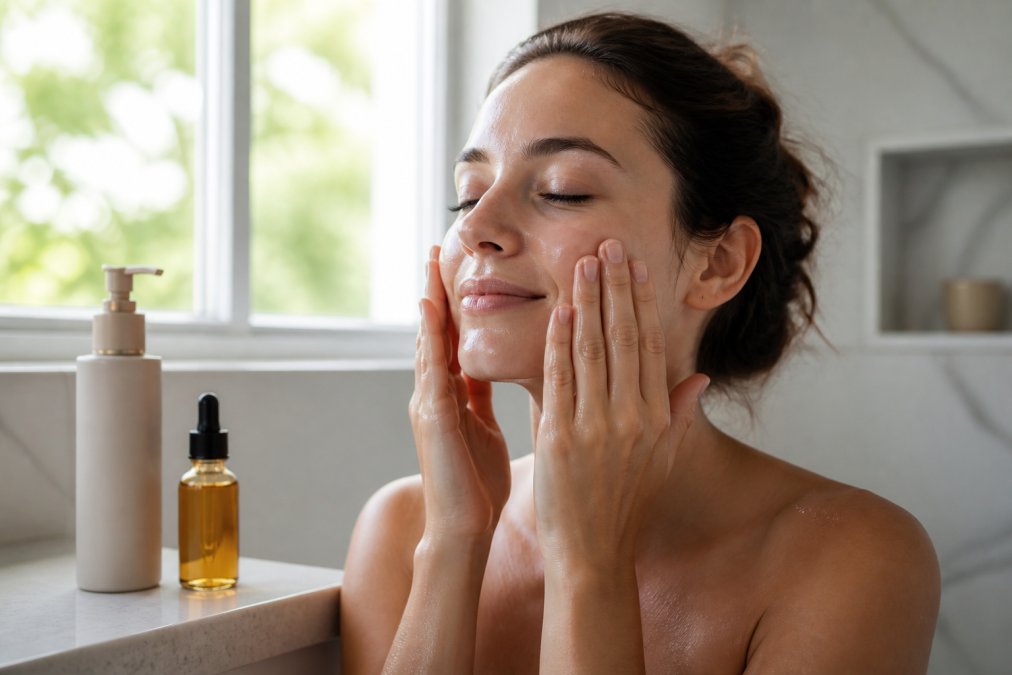
Follow these rules:
- Use lukewarm water. Hot water strips lipids fast.
- Cleanse once at night. In the morning, rinse with water only.
- Skip the washcloth. Use your fingertips.
- Keep it under 30 seconds. Longer is not cleaner.
- Pat dry, leave skin damp. Do not towel off completely.
Step 3: Rebuild the Lipid Barrier With Ceramides and Fatty Acids
A healthy lipid barrier is ceramides, fatty acids, and cholesterol in roughly equal parts. Your moisturizer should replace what is missing.
Ingredients to look for:
- Ceramides (often listed as ceramide NP, AP, or EOP)
- Niacinamide at low strength, which supports the skin microbiome and pH balance
- Fatty acids from plant oils and butters
- Hyaluronic acid for moisture retention
- Panthenol and colloidal oatmeal for calming redness
Ingredients to avoid while healing:
- Fragrance and essential oils in high concentrations
- Denatured alcohol
- Physical scrubs
- AHA and BHA acids
- Retinoids and retinoid-adjacent products
Best Natural Oils for Skin Barrier Repair
Not all oils are equal: some seal on top, others sink in and feed the barrier. The best do both.
| Oil | Main Benefit | Best For |
|---|---|---|
| Jojoba | Closest to skin's own sebum | All skin types, including combination |
| Squalane | Lightweight, non-comedogenic | Oily and acne-prone skin |
| Rosehip | Natural vitamin A and fatty acids | Dry, dull, or mature skin |
| Tallow | Rich in fat-soluble vitamins | Very dry or compromised skin |
| Marula | High in oleic acid, absorbs fast | Normal to dry skin |
Skin Barrier Repair Timeline: What to Expect Week by Week
The skin barrier repair timeline is slower than most expect. The stratum corneum turns over roughly every 28 days, so improvement shows in days but full recovery takes weeks. Mild damage often calms in one to two weeks; moderate damage takes four to six weeks; severe or chronic damage can take eight to twelve weeks or longer, and may need a dermatologist.
A realistic week-by-week picture:
- Week 1, Calming phase. Stinging and redness ease as surface inflammation drops. Skin may still feel tight because lipid levels have not caught up. Expect little visible change; this is the week most people quit.
- Week 2, Stabilizing phase. Flaking reduces and products stop burning on contact as transepidermal water loss begins to fall.
- Weeks 3-4, Rebuilding phase. Moisture retention improves noticeably and skin feels less reactive. This is the earliest point most practitioners suggest reintroducing a single active.
- Weeks 5-6, Consolidating phase. Elasticity returns and the lipid matrix is roughly back to normal. Reintroduce a second active, slowly.
- Weeks 7-8, Restored phase. Barrier is largely functional. Add back products one at a time, five to seven days apart.
- Weeks 9-12, Maintenance phase. For moderate-to-severe damage, this is when skin finally tolerates its old routine again, if you want it to.
How to reintroduce products without re-damaging the barrier
Reintroduction is where most people undo their progress. The rule: one product at a time, five to seven days apart, lowest strength first.
- Start with the least aggressive active. Niacinamide at 2-5%, or lactic acid at 5% or less, before retinoids or AHAs.
- Buffer it. Apply the active over your moisturizer, not under it, for the first two weeks to slow absorption and reduce irritation.
- Use it every third night for the first week, then every other night, then nightly, only if skin stays calm at each step.
- Do not stack. One active at a time. No acid plus retinoid in the same routine while you are rebuilding.
- Keep the boring base. Your gentle cleanser, barrier moisturizer, and mineral SPF stay in place permanently. They are not a phase.
What to do if you flare up again
A flare during recovery is common. It usually means you reintroduced something too fast, hit a stress or sleep disruption, or have an underlying condition that mimics barrier damage.
- If stinging returns within 48 hours of a new product: stop it, return to the three-product base for one week, then retry at half the frequency.
- If redness and flaking return without a new product: look at sleep, stress, diet, and weather. Cold, dry air and indoor heating both spike water loss.
- If nothing improves after four weeks of gentle care: see a dermatologist. Rosacea, eczema, seborrheic dermatitis, and perioral dermatitis all present as "barrier damage" but need different treatment, and some, like perioral dermatitis, get worse with heavy occlusives.
When to see a dermatologist
Book an appointment if you have any of the following:
- No improvement after four weeks of gentle care
- Yellow or honey-colored crusting, weeping, or pus, possible infection
- Painful, spreading redness or swelling
- A rash after a new medication or product that does not resolve in a week
- Symptoms that keep returning despite good home care
- A personal or family history of eczema, rosacea, or psoriasis
What to Avoid While Your Barrier Heals
The fastest way to slow recovery is to keep doing what caused the problem, plus two internal levers almost no one mentions.
Topical avoid-list, until skin is calm:
- Exfoliation of any kind, AHAs, BHAs, enzyme powders, scrubs, and cleansing brushes remove corneocytes faster than a compromised barrier can replace them
- Retinoids and prescription acne treatments (tretinoin, adapalene, tazarotene, high-strength benzoyl peroxide)
- Chemical peels and at-home acid treatments, including "gentle" 5% lactic toners
- Hot showers, saunas, and steam rooms, heat dilates capillaries and accelerates water loss through the leaky barrier
- Alcohol-based toners and astringents, plus high-concentration fragrance and essential-oil blends
- Sunscreen-free days, even indoors near windows, UVA passes through glass and degrades barrier lipids
- Cleansing more than once daily, and any cleanser that leaves skin tight after rinsing
The internal lever most guides skip: diet and hydration
Your barrier is built from the inside out: the stratum corneum is roughly half water by weight, and its lipids come from dietary fats.
- Water and electrolytes. Chronic mild dehydration shows up first as tightness and dullness. Aim for pale-yellow urine, and add electrolytes if you sweat heavily or drink a lot of coffee.
- Omega-3 fatty acids. EPA and DHA from fatty fish (salmon, sardines, mackerel) and ALA from flax, chia, and walnuts support the lipid matrix and help modulate inflammatory signaling. Most practitioners suggest two servings of fatty fish per week, or a supplement.
- Zinc and vitamin C. Both are cofactors in collagen synthesis and wound repair. Zinc is in oysters, beef, pumpkin seeds, and chickpeas; vitamin C in citrus, bell peppers, and broccoli.
- Ultra-processed food and added sugar. High-glycemic diets are associated with more systemic inflammation, which shows up as redness and reactivity. You need fewer inflammatory inputs while the barrier is rebuilding, not a perfect diet.
- Alcohol. It is a diuretic and a vasodilator. A heavy night often shows up as next-day flushing and tightness.
The stress-skin axis: why your nervous system is part of your routine
Your skin has its own stress-response system, the hypothalamic-pituitary-adrenal (HPA) axis and local cortisol signaling, and chronic stress keeps it switched on, slowing barrier recovery, reducing lipid synthesis, and increasing reactivity to irritants.
What actually helps:
- Sleep. Seven to nine hours. Barrier recovery happens largely overnight; short sleep blunts it.
- Caffeine ceiling. Two cups before noon, then switch to water or herbal tea. Caffeine raises cortisol and is a mild diuretic.
- Movement. A 20- to 30-minute walk most days lowers circulating stress hormones more reliably than most supplements.
- Breathwork or meditation. Even five minutes of slow breathing before bed shifts parasympathetic tone.
- Stop the mirror checks. Compulsive checking and picking is a stress loop that keeps skin inflamed. Cover the mirror if you have to.
The five-to-seven-day skin fasting protocol
If you cannot tell which product is causing the problem, a short skin fasting reset strips your routine to the minimum so your skin can tell you what it needs.
Frequently Asked Questions
How can I naturally repair my damaged skin barrier?
Cut your routine to a gentle, soap-free cleanser, a moisturizer with ceramides or fatty acids, and sunscreen. Apply products to damp skin to improve moisture retention, and skip exfoliation, retinoids, and chemical peels until redness and stinging fade. Natural oils rich in fatty acids, such as tallow-based balms or jojoba, can support the lipid barrier when layered over damp skin. Most people see improvement within two to four weeks of consistent, minimal care.
How do I tell if my skin barrier is broken?
The most common signs of a damaged skin barrier are persistent redness, stinging when you apply products that used to feel fine, tightness after cleansing, flaking, and increased sensitivity. Some people notice breakouts or a shiny, waxy texture as the skin overproduces oil to compensate for dehydration. If your usual routine suddenly burns or your skin looks irritated for more than a few days, treat it as a compromised barrier and simplify your products.
How long does a damaged skin barrier take to heal?
A mild barrier disruption from over-exfoliation often settles in one to two weeks once you remove the irritant. Moderate damage from retinoids or chemical peels typically takes two to four weeks. Severe cases involving chronic inflammation can take six to eight weeks or longer. The skin barrier repair timeline depends on how long the damage went on, your age, and whether you keep using the products that caused it.
What are the best natural ingredients for skin barrier repair?
Look for ceramides, niacinamide, hyaluronic acid, and fatty acids, which support the lipid barrier and moisture retention. Natural oils high in linoleic and oleic acids, such as jojoba, rosehip, and tallow-based balms, work as emollients and occlusives to reduce transepidermal water loss. Panthenol and colloidal oatmeal calm irritation. Patch testing any new oil on your inner arm for 24 hours helps you avoid a reaction before applying it to your face.