
Table of Contents
- What Beef Tallow Is and Why It's Used on Skin
- Beef Tallow Skincare Research: What Studies Actually Show
- How Beef Tallow May Moisturize Skin
- Beef Tallow for Dry Skin: What to Expect
- Is Beef Tallow Comedogenic? Pore-Clogging Risk Explained
- Tallow Balm Shelf Life and Product Quality
- Who Should Avoid Beef Tallow or Use Extra Caution
- Conclusion
- Frequently Asked Questions
Last Updated: October 14, 2026
What Beef Tallow Is and Why It's Used on Skin
Beef tallow is rendered fat from cattle, and it has become one of the most debated ingredients in natural skincare. This guide from Beach Goddess Skin Care examines what the evidence actually supports, what remains unproven, and how to use tallow wisely.

Tallow comes from suet, the hard fat around the kidneys and loins. When gently heated, it separates into a clear liquid fat that solidifies into a smooth, shelf-stable balm.
The appeal is easy to understand. Tallow is rich in fatty acids that closely resemble the lipids in human skin, and it contains fat-soluble vitamins. Whether that translates into measurable benefits is a separate question, and one this article answers honestly.
How Tallow Is Rendered and Refined
Rendering is the process of melting raw fat to separate pure tallow from connective tissue and water. Slow, low-heat rendering produces a cleaner, less odorous fat than fast, high-heat methods.
A common mistake is assuming all tallow is identical. Quality varies significantly with the source animal's diet and the rendering method. Grass-fed suet rendered at low temperatures tends to produce a whiter, milder balm.
Beef Tallow Skincare Research: What Studies Actually Show
Here is the honest answer: beef tallow skincare research is thin, and the quality of evidence varies enormously depending on which claim you are evaluating. Most articles lump every claim together and conclude that evidence is "limited." That is unhelpful. A better approach is to grade each claim by the type and strength of evidence behind it.
Evidence Grading by Claim
| Claim | Type of Evidence | Strength |
|---|---|---|
| Tallow can moisturize and soften skin | Established ingredient chemistry (emollient and occlusive mechanisms) | Reasonable basis |
| Tallow resembles skin's natural lipids | Fatty-acid composition analysis | Reasonable basis, with caveats |
| Tallow supports the skin barrier | Ingredient chemistry plus limited laboratory work | Plausible, not proven |
| Tallow helps eczema or other skin conditions | No controlled human trials of tallow specifically | Unproven |
| Tallow reverses aging or boosts collagen | No direct evidence | Unsupported |
| Tallow improves the skin microbiome | Laboratory and theoretical work only | Speculative |
Notice the pattern. The claims closest to basic moisturization rest on well-understood mechanisms. The claims furthest from moisturization, treating medical conditions, reversing aging, reshaping the microbiome, rest on nothing more than marketing momentum.
Where the Evidence Comes From
It helps to separate four tiers of evidence, because they are not interchangeable:
- Ingredient chemistry. Oleic acid is a recognized emollient. Palmitic and stearic acids are recognized occlusives. This tier is solid and well documented in dermatology textbooks.
- Laboratory work. Studies on fatty acids in cell cultures or on skin models suggest barrier interactions, but lab results do not always translate to living skin.
- Animal studies. Some wound-healing research uses animal fats, but species differences and study design limit how far those findings stretch to human skincare.
- Human trials. Here the record is nearly empty for tallow specifically. No large randomized controlled trial has tested a tallow balm as a standalone moisturizer against a standard emollient.
What Would Establish Clinical Benefit
To move tallow from "plausible" to "proven," researchers would need randomized controlled trials comparing a tallow product against a neutral control, measuring outcomes like transepidermal water loss, skin hydration, and barrier recovery over several weeks.
The National Center for Complementary and Integrative Health notes that natural ingredients still carry real potential for irritation and interaction, and that "natural" is not the same as "proven safe for every person."
Fatty Acid Profile and Skin Lipid Similarity
Tallow's fatty acids include oleic acid, palmitic acid, stearic acid, and smaller amounts of linoleic acid. Oleic acid is a well-known emollient that softens skin. Palmitic and stearic acids are saturated fats that form a protective layer and give tallow its firm texture.
Human sebum contains many of these same fatty acids, which is the basis for the "biocompatibility" argument. The overlap is real, though not identical.
| Fatty Acid | Role on Skin | Notes |
|---|---|---|
| Oleic acid | Emollient, softens | Higher in tallow than linoleic |
| Palmitic acid | Barrier support | Saturated, firm texture |
| Stearic acid | Occlusive layer | Contributes to solidity |
| Linoleic acid | Barrier function | Present in smaller amounts |
How Beef Tallow May Moisturize Skin
Tallow moisturizes through two mechanisms: as an emollient that softens and smooths, and as an occlusive that slows water loss from the skin's surface.
The key difference from many commercial creams is how it absorbs. A quality tallow balm melts at skin temperature and sinks into the layers rather than sitting on top as a greasy film.
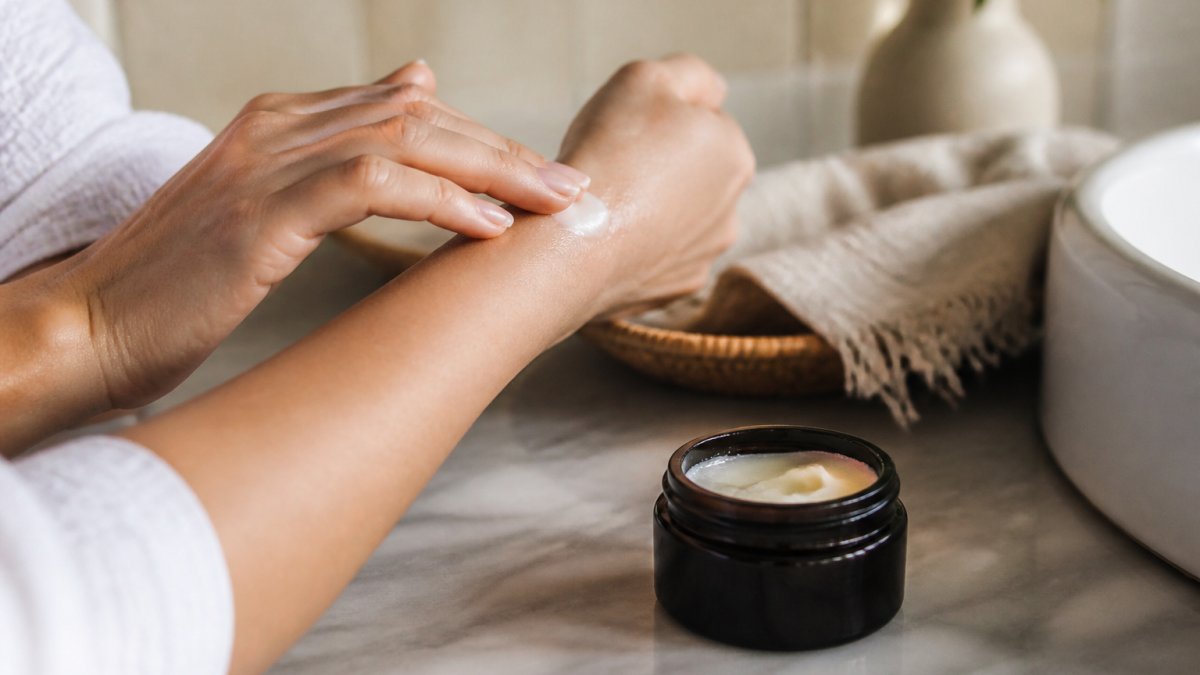
Fat-soluble vitamins occur naturally in tallow, including vitamins A, D, E, and K.
Beef Tallow for Dry Skin: What to Expect
For dry skin, tallow is one of the more sensible natural options because its occlusive fats reduce moisture loss.
Expect the first application to feel rich, then absorb within a few minutes. Most people see softer, less tight-feeling skin within a week of daily use.
A practical patch test takes three days:
- Day 1: Apply a pea-sized amount to the inner forearm, morning and night
- Day 2: Check for redness, itching, or bumps at the site
- Day 3: If no reaction, test a small area of the jawline before full-face use
Stop and consult a dermatologist if irritation develops. Anyone with a known allergy to dairy or beef should be cautious, since tallow is an animal-derived fat.
Is Beef Tallow Comedogenic? Pore-Clogging Risk Explained
Tallow's comedogenic rating is debated, and no reliable rating scale exists for it. The honest position is that heavy, occlusive fats can clog pores in some people, especially those prone to acne or with oily, combination skin. But "some people" is not useful guidance. What matters is matching the fat to your skin type and knowing the warning signs.
Skin-Type Guidance
| Skin Type | Cautious Approach | Watch For |
|---|---|---|
| Dry or mature | Thin layer, morning and night | Rare irritation; usually well tolerated |
| Normal or combination | Thin layer on dry zones only | Congestion in the T-zone |
| Oily | Spot-test on dry patches first | Breakouts within 7-10 days |
| Acne-prone | Patch test, then use only on dry areas | New closed comedones or cysts |
| Sensitive or reactive | Patch test 3 days before wider use | Redness, itching, stinging |
Why Oleic Acid Matters Here
Oleic acid, which tallow contains in meaningful amounts, is considered more comedogenic than linoleic acid. That does not mean tallow will break everyone out. It means acne-prone users should introduce it slowly and watch their T-zone.
A common mistake is layering tallow over oily skin without cleansing first. Trapping oil and dead skin under an occlusive layer is a recipe for congestion. Cleanse gently, apply a thin layer, and give it a week before judging.
Plausible Concerns vs. Demonstrated Harms
It is worth separating what is plausible from what is proven:
- Plausible concerns. Pore congestion in acne-prone skin, irritation from added botanical oils or fragrance, and allergic reaction in people with beef or dairy allergies.
- Demonstrated harms. True contact allergy to tallow itself is rare but documented. Rancid or oxidized fat is a more common trigger for irritation than fresh tallow.
- Not supported. Claims that tallow is universally non-comedogenic, or that it is universally pore-clogging, both overstate what is known.
When to Stop
Stop using tallow and consult a dermatologist if you develop persistent redness, itching, swelling, or a cluster of new bumps that does not resolve within a few days of discontinuing use. People with active acne, rosacea, or seborrheic dermatitis should ask a professional before adding a heavy fat-based product.
Beach Goddess Skin Care products are 100% natural tallow and oils with no synthetics, toxins, or unnatural preservatives (vitamin E is the only preservative used). The products absorb into the skin instead of sitting on top like supermarket brands, and daily use of the natural tallows and oils can reduce fine lines and keep skin soft, glowing, and toxin-free. Even so, daily use of natural tallows and oils works best when introduced gradually, so your skin has time to adjust.
Tallow Balm Shelf Life and Product Quality
Tallow balm shelf life typically runs six to twelve months when stored cool and dark, though this varies with formulation. Vitamin E slows oxidation, but no natural fat lasts forever.
Signs a balm has turned: a sharp or rancid smell, a changed color, or a grainy, separated texture. Heat accelerates spoilage, so keep jars out of direct sunlight and away from steamy bathrooms.
Quality comes down to formulation. Beach Goddess Skin Care's Face Tallow blends tallow with six botanical oils, blue tansy, and arnica, and the 2 oz jar lasts about a month with twice-daily use. For those who prefer a bar format, [the Ocean Surf Soap pairs tallow with goat milk and activated charcoal](/products/ocean-surf-soap-2-8oz-bar).

| Quality Signal | What to Look For | Red Flag |
|---|---|---|
| Ingredient list | Short, recognizable fats and oils | Long list of synthetic additives |
| Scent | Mild, clean, faintly nutty | Sharp, sour, or chemical |
| Texture | Smooth, melts on contact | Grainy or separated |
| Packaging | Small jars, opaque or dark glass | Clear jars in bright light |
Who Should Avoid Beef Tallow or Use Extra Caution
Tallow is not right for everyone. People with beef or dairy allergies should avoid it, and anyone with active acne, rosacea, or seborrheic dermatitis should test carefully or ask a dermatologist first.
Sensitive skin deserves caution too. Botanical oils and essential oils, even natural ones, can trigger irritation in reactive skin. Patch testing is not optional for this group.
The American Academy of Dermatology recommends patch testing new products on a small area before widespread use, particularly for people with known sensitivities.
Conclusion
The science behind beef tallow for skin is promising but incomplete. Its fatty-acid profile gives good reason to expect moisturizing, barrier-supporting behavior, and its emollient and occlusive properties are well understood.
For those who want a simple, fat-based moisturizer, tallow is a reasonable choice when sourced and formulated well. Beach Goddess Skin Care builds its face tallow and body products around 100% natural tallows and oils with no synthetics, toxins, or unnatural preservatives (vitamin E is the only preservative used).
Frequently Asked Questions
Is there scientific evidence that beef tallow helps skin?
The evidence is limited but not absent. Beef tallow contains fatty acids like oleic, linoleic, stearic, and palmitic acid that resemble some of the lipids found in human sebum. This similarity supports its use as an emollient and occlusive, meaning it can soften skin and slow moisture loss. However, large clinical trials specifically on tallow as a skincare ingredient are scarce, so most claims rest on its fatty acid composition and anecdotal reports rather than controlled studies.
Is beef tallow comedogenic? Can it clog pores?
Beef tallow is generally considered moderately comedogenic, meaning it can clog pores for some people, especially those with oily or acne-prone skin. Its stearic and palmitic acid content gives it a heavier texture than lighter oils. If you have combination or acne-prone skin, patch test on a small area first. Beach Goddess Skin Care's Face Tallow is infused with six different botanical oils, blue tansy, and arnica.
Can beef tallow moisturize dry skin effectively?
Yes, beef tallow can work well for dry skin because it acts as an occlusive, forming a barrier that reduces transepidermal water loss. Its emollient fatty acids also soften rough patches. For very dry or compromised skin, applying tallow after a light mist of water can help lock in hydration. Beach Goddess Skin Care's Face Tallow is designed to absorb into the skin rather than sit on top, which many users find more comfortable than heavier supermarket moisturizers.
What is the shelf life of tallow balm?
Tallow balm shelf life typically ranges from 6 to 12 months when stored in a cool, dark place and kept free of water contamination. Because tallow is an animal fat, it can go rancid over time, especially if exposed to heat or direct sunlight. Beach Goddess Skin Care uses vitamin E as its only preservative, which helps slow oxidation. If your balm smells sharp or changes texture, it is past its prime and should be replaced.